The suspicious arrest and detention of Adil Charkaoui, Page 2
Once in court, the facts of the case are not what is judged. Rather, all a judge has to determine is whether the certificate is "reasonable." In the "Suresh" security certificate case, for example, the judge stated, "I am here to determine whether there exists sufficient evidence for me to conclude as to the reasonableness of the certificate signed by the ministers. It is not for me to determine whether the ministers were correct in their assessment of the evidence." In the Mahjoub security certificate decision, the judge stated that all that is necessary for CSIS and the government to prove are " 'reasonable grounds to believe certain facts' as opposed to the existence of the facts themselves."
Even the Federal Court judges before whom the secret trials are conducted are apparently unhappy with the process. Federal Court Justice James K. Hugessen recently made these remarkable statements at a conference in Montreal last year: "All the national security functions which are laid on the Federal Court have this in common: they involve at one stage or another and sometimes throughout the piece a judge of the Court sitting alone in what are called hearings, but they are held in the absence of one of the parties.. That is to say ex parte so that the judge may, if he or she sees fit, take communication of the evidence, the information which is said to be too sensitive to be allowed to be revealed to the person concerned and not only evidence, but also argument which may rely on the evidence or may deal with matters which may be too sensitive to be revealed to the public.
"This is not a happy posture for a judge, and you are in fact looking at an unhappy camper when I tell you about this function. Often, when I speak in public I make the customary disavowal that I am not speaking for the Court and I am not speaking for my colleagues but I am speaking only for myself. I MAKE NO SUCH DISAVOWAL THIS AFTERNOON. I CAN TELL YOU BECAUSE WE TALKED ABOUT IT, WE HATE IT. WE DO NOT LIKE THIS PROCESS OF HAVING TO SIT ALONE HEARING ONLY ONE PARTY AND LOOKING AT THE MATERIALS PRODUCED BY ONLY ONE PARTY AND HAVING TO TRY TO FIGURE OUT FOR OURSELVES WHAT IS WRONG WITH THE CASE THAT IS BEING PRESENTED BEFORE US AND HAVING TO TRY FOR OURSELVES TO SEE HOW THE WITNESSES THAT APPEAR BEFORE US OUGHT TO BE CROSS-EXAMINED.
"If there is one thing that I learned in my practice at the Bar, and I have managed to retain it through all these years, it is that good cross-examination requires really careful preparation and a good knowledge of your case. And by definition, judges do not do that. We do not get to prepare our cases because we do not have a case and we do not have any knowledge except what is given to us and when it is only given to us by one party we are not well suited to test the materials that are put before us. WE HATE HEARING ONLY ONE PARTY. WE HATE HAVING TO DECIDE WHAT, IF ANY, SENSITIVE MATERIAL CAN OR SHOULD BE CONVEYED TO THE OTHER PARTY. WE HATE, OR I CERTAINLY DO, I AM NOT SURE EVERYBODY FEELS THE SAME ABOUT THIS, SITTING IN A BUNKER, IN A SEALED WINDOWLESS COURTROOM DEEP IN THE BOWELS OF A BUILDING IN OTTAWA WHERE THE AIR IS TERRIBLE, THE ONLY THING THAT IS GOOD IS THE COFFEE, BUT WE HATE IT. I DO NOT THINK IT MAKES US DO OUR JOB PARTICULARLY WELL. We greatly miss, in short, our security blanket which is the adversary system that we were all brought up with and that, as I said at the outset, is for most of us, the real warranty that the outcome of what we do is going to be fair and just."
Hugessen later says, "If you have a case that is only being presented on one side, you are not going to get a good case.... It does occur to me, however, that it might be helpful if we created some sort of system somewhat like the public defender system where some lawyers were mandated to have full access to the CSIS files, the underlying files, and to present whatever case they could against the granting of the relief sought. I am told that this already happens within the CSIS, that within the CSIS the case has to be made for concealment and has to carry over a case presented by other CSIS officers who have access to all the material. But, if that is the case, then I am not sure what the judges of the Federal Court are doing in this picture and if I may be forgiven for using the expression, I sometimes feel a little bit like a fig leaf."
CSIS: Incompetence, Bias and Abuse
The flimsy nature of the information that grounds the security certificate is reflected in criticisms of CSIS made by its oversight committee, the Security Intelligence Review Committee (SIRC), which is traditionally a committee that tries its best not to be too critical of CSIS. Nevertheless: * SIRC's 1999-2000 report raises questions "about some beliefs the Service has about the nature of the threat. We are of the opinion that these beliefs are sometimes overdrawn." * The SIRC report points out one instance, likely illustrative of many more, in which a CSIS application for warrant powers contained "a number of overstatements." * In another case, "information put forward was more than a decade old and the information adduced was derived from one source's 'feelings.' * "One source's speculation was quoted. Some assertions that the target engaged in 'suspicious activities' appeared to us to be misleading or exaggerated." * "For another person targeted, [CSIS] failed to include in the affidavit significant information of which it was aware which contradicts its own position on the person." * In yet another case, a hyperactive CSIS treated as a threat activity that "seemed to be routine diplomatic behaviour," while in another case, "with little corroborating information, CSIS ascribed intelligence gathering motives to apparently normal consular contacts." * SIRC concludes we need the best possible national security advice "unencumbered by unfounded speculation."
In addition, CSIS agents are generally not as knowledgeable as they make themselves out to be. Witness the incompetence of CSIS displayed in the following exchange from the hearing of Mahmoud Jaballah, originally printed in Saturday Night:
"David,", a self-described expert on Middle East terrorism, was asked by Jaballah's lawyer, Rocco Galati, what constituted an Arabic country, to which "David" replied, "More often than not, countries in the Middle East." Galati then asked whether Iran were an Arabic country.
"I would say it is Arabic, but I'm not an expert in Iranian affairs," David said.
"You are completely wrong, Iran is as far from being Arabic as Germany is," Galati replied.
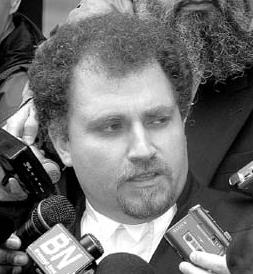
photo by Yahya Abdur Rahman, originally
published in The Montreal Mirror.
Galati continued, "If I suggested to you that your experience is anemic and that you need some re-education, what would you say to me?"
David said, "I would say that the Service goes to great effort to make sure that their people are properly trained and culturally sensitized. We do have training in that area."
Galati followed up by asking, "Can you name me the Arabic countries along the North African coast?"
David could not.
"Could you tell me the population of Egypt?" Galati asked the "expert" "David."
David could not.
FINDING SOMEONE TO BLAME
CSIS is a spy agency in search of enemies. To justify its massive budget increase following Sept. 11, 2001, it needs to come up with new "threats" to maintain its new funding levels.
Mr. Charkaoui and his family are not alone right now in Canada. Others are currently fighting the certificate process, including Mahmoud Jaballah, a father of six kids, who was arrested in 1999 and held seven months before he was released in an unprecedented move, in which the Federal Court found that Jaballah was credible and CSIS was not. A year later, a disgruntled CSIS brought a new certificate against Jaballah, admitting in court they had no new evidence, only new "interpretations" of "evidence' already found not credible by the court.
Muhammad Mahjoub (two children) has been in jail since June, 2000 on a certificate. Hassan Almrei has been in jail since October 2001, and Mohamed Harkat since December 10, 2002.
Interestingly, the security certificate was used against Holocaust denier Ernst Zundel recently. Although Zundel has a right to know the case against him as well, one has to wonder whether CSIS is using the certificate (when other, less harsh legal measures to deal with Zundel are available) to show it is being "evenhanded" in repression.