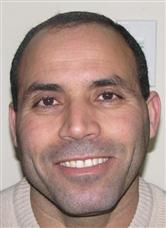
Defending Charkaoui
Date: June 5 2003
Toronto civil liberties lawyer Rocco Galati has seen it all before, and doesn't like it
The flyer put out by the Justice Coalition for Adil Charkaoui asks, "Imagine that you've been arrested, held without charge, told you are a threat to Canada's national security, and neither you nor your lawyer is allowed to know why." It doesn't go on to suggest what the reader could do in that situation, but if it did, it might say, "Sit tight, don't say anything and wait for your friends to call Rocco Galati."
The Toronto-based civil liberties lawyer was in town last Friday representing suspected terrorist Adil Charkaoui at his security certificate hearing. After a bail hearing was scheduled for July 2 (unusual in a security certificate case, and a small victory for the defence), Galati had some angry words on the security certificate process as a whole.
"This is a non-judicial arrest warrant, an arrest by executive fiat," he says. "It goes against everything in the Western legal tradition and its constitutionality has never been ruled on by the Supreme Court of Canada."
Charkaoui believes that the Canadian Security Intelligence Service is punishing him for refusing to provide names of the students in his mosque-based karate class. Muslim Council of Montreal president Salam Elminyawi, who retained Galati on Charkaoui's behalf, wouldn't say if he personally believes Charkaoui's story, but he admits the request for names is consistent with CSIS procedure as described by other Montreal Muslims.
Certificated and detained
Being in the process of defending several people detained on security certificates, Galati knows how tough it can be. Last January, at the Toronto trial of another one of his clients, Abdellah Ouzghar, Galati called as witnesses the two CSIS agents who were said to have demanded that his client name names. They refused to give straight answers to many of Galati's questions, often citing reasons of national security. The question of whether the agents can be forced to answer all of Galati's questions has been appealed to the Ontario Superior Court.
In March 2002, when Toronto judge Andrew MacKay prevented him from seeing the evidence against a different client, Mahmoud Jaballah, Galati gathered up his papers and walked out of the courtroom. He told the judge the procedure was neither fair nor independent, and that he could not in good conscience help pretend it was.
MacKay made a ruling last month anyway, one that leaves Jaballah in legal limbo. He won't be deported to his native Egypt, where he was sentenced to death in absentia. He also won't be released from jail in Canada, where he's been held for the last two years, despite the fact that he's never been charged, much less convicted, of any crime in Canada.
Summaries and secret evidence
Galati's job of defending suspected terrorists is made more difficult by the fact that he never gets to see all of the evidence against his clients, only summaries. Normally, when a prosecutor introduces hearsay, speculation or otherwise inadmissible evidence, it's up to the defence lawyer to challenge it. The judge will not throw it out on his own. According to Galati, the secret evidence provisions allow the Crown to introduce triple hearsay, newspaper clippings and statements about informants' feelings as evidence. "Whenever there has been public scrutiny, their evidence has been laughed out of court," he says.
"A normal arrest warrant requires probable cause. That means you need to be more than 50 per cent sure [the suspect is guilty] to lock someone up," he says, describing how the security certificate process compounds three layers of uncertainty. "Here, the Minister signs the certificate based on a probability not that someone is a threat, but that they may be a threat. Then the judge has to agree it's ‘reasonable to believe,' not that it's ‘beyond reasonable doubt' - so the standard of proof is lower. Put it all together and you can lock someone up if it's reasonable to believe it's probable he may be a threat. It's all smoke and mirrors."
In a Gazette interview last week, former CSIS head Reid Morden cited the fact that only three of 27 certificates were found to be unreasonable as proof that the system works. Galati says it's proof that CSIS works the system.
"Not all judges are allowed to hear CSIS cases," he claims. "Judges need to get security clearances before they can hear security cases - and CSIS writes the security clearances."