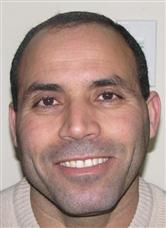
Mahjoub Bail Hearing Report: Trickle-Down Democracy, Part II
She is followed by Head of Security at the West, Frank Geswaldo, a soft-spoken man who details the command structure at the jail and says as many as 15-20% of the detainees there are immigration holds. He is bemused that there actually is a range called immigration, given that it is no different than any other range at the facility. "My question is what's the difference?" he says. "Cells are cells, a unit is a unit."
Geswaldo says Mahjoub has never posed a management problem, has never been charged with misconduct, and confirms no complaints have been received about his behaviour.
He is followed by prison health care coordinator Mary Dwyer, who talks about Mahjoub's medical history at the jail. She notes he arrived in 2000 as a healthy person, complaining of some lower back pain and, reading from the doctor's notes, of "assault on arrest."
She often refers to Mahjoub as the "offender," even though he has not broken the law -- he is detained without charge.
Dwyer also talks about hunger strikes as if they are common colds, something which must often be seen at the facility (those on hunger strike are often sent to solitary, which is next to the nursing area).
Dwyer says Mahjoub requested to see a psychiatrist who said, after Mahjoub's first 18 months of incarceration, that he may have an "adjustment disorder" (surprise surprise), that he was anxious and had difficulty sleeping. He did go on hunger strike during a freezing stretch in solitary confinement, and has since complained of exhaustion, dizziness, and kidney problems. It has taken long periods of time for him to see specialists, and on January 6, 2004 Mahjoub was diagnosed with Hepatitis C. Dwyer says there are no plans to isolate prisoners who do have Hep C -- they are given a pamphlet on it, and advised to eat a healthy diet and try to reduce stress. This no doubt comes as comfort to Mahjoub, who struggles with the prison diet and has been in solitary confinement since March.
Jackman asks if there has been an investigation into how, after 4 years, Mahjoub now has Hep C. None that Dwyer is aware of.
The next morning, Mahjoub is led through testimony about his detention and torture in Egypt by attorney John Norris. Never granted access to a lawyer -- these things are not allowed in Egypt at all, he says -- Mahjoub was threatened with life imprisonment, with the arrests of his brothers (which actually occurred after he got refugee status in Canada), and the arrest of his elderly mother.
Mahjoub described what is known as the "reception ceremony," during which he was blindfolded and beaten by 6 guards, using fists, feet and sticks.
"The objective is to break the detainee prior to the questioning," he says. Electrical rods were attached to sensitive areas of his body, cold water was thrown on him, after which a fan was directed against him, and he was often kept in a solitary confinement cell which was flooded so he was unable to sit or sleep. Other times he was suspended from the ceiling by his hands or his feet.
"A doctor is there so if you lose consciousness, he intervenes to stop further complications," Mahjoub says.
There is also psychological torture--a ladder is drawn on the wall and the detainee is told to climb it, or a TV set is drawn on the wall and the detainee is told to turn it on, and if neither happens, there is more torture.
He is asked about food.
"It is embarrassing, even ridiculous, to talk about food in Egyptian prisons," he says. The bread was often very old and hard, often encrusted with dirt, and often times they were fed only highly salted beans, causing an unquenchable thirst after which water would be denied. Sleep deprivation was also employed. Mahjoub was never charged nor sent to court.
He left Egypt in 1991, on the advice of one of the investigating officers who told him he might be sent to prison, without explanation, for the rest of his life.
Mahjoub then discusses the long, hard journey he has travelled at Metro West, interrupted by a two-month, unexplained transfer to Millbrook.
As a devout Muslim, it was hard at first to establish a safe space for daily prayers -- he and two other Muslim prisoners asked fellow inmates to give them 5 to 10 minutes of quiet time. Until August of 2003, he was in a cell with two bunks and someone sleeping on the floor, making it very difficult for him to pray during cell time.
Mahjoub says that despite many complaints, it was only recently that he began to receive Halal food. Throughout the day, Mahjoub details a litany of humiliations he faces as a Muslim in an institution which does not meet his spiritual, physical and psychological needs.
He discusses the many strip searches he has endured. "As a Muslim man, does this cause you problems?" Norris asks.
Mahjoub starts to cry. "A strip search is an attack on my manhood. If I refuse I would be beaten. Every time I try to explain to guards that this is humiliating to a Muslim, especially in front of other inmates."
He has suggested alternatives, such as taking off all of his clothes saves for his underpants.
"I ask not to stand naked in front of jail staff or other inmates. They tell me: 'this is Canada, this is jail policy.'"
He relates how he was once strip searched in front of female staff.
"I tried to explain to the guard this was unacceptable, and his answer was: here is the ombudsman's telephone number."
Mahjoub felt terribly isolated, a condition which worsened after Sept. 11, 2001, when he found he was unable to contact members of the Muslim community because everyone was afraid. "I had no choice but to remain quiet until this court hearing."
In all the strip searches, nothing has ever been found on his person.
Norris asks whether the showers are private or communal. It is a question which brings to the surface one too many humiliations for Mahjoub, and he breaks down sobbing.
It is a tense moment. His wife is across from him, not 20 feet away in the visitor's gallery, yet unable to reach out and comfort her husband as he weeps on the stand. Police officers and government lawyers smirk and giggle during a ten-minute break. Four years of pain, degradation, humiliation, and fear rise to the surface, and Mahjoub's tears fall freely.
He is very quiet for the rest of his testimony, trying to hold back the emotional flood raging inside. He discusses showering with his underpants on, since there is no privacy, and the humiliation of having to pray in the direction of the open toilet in his solitary cell He recounts an incident where he had high blood pressure, dizziness, fever, extreme exhaustion, and was thrown into segregation rather than given medicine. It is unclear how many times such things have occurred; one senses it is a constant state of anxiety that comprises his life.
He expresses no concerns about other inmates. "Though the inmates would sometimes call me a terrorist, thank God one can manage and deal with the situation."
The last two days of the hearing are taken up with in camera (behind closed doors) arguments about whether or not Mahjoub should be allowed to offer a few minutes of testimony without the public in the courtroom. Barbara Jackman, one of his lawyers, states that she cannot publicly offer reasons for, or evidence to support, the need for this session because to do so would create a situation of risk and be prejudicial to Mahjoub.
This motion is vigorously opposed by government lawyers and a lawyer for the Toronto Star. It is an Orwellian moment as government lawyers who rely on complete secrecy in presenting their case in the security certificate hearing are now crowing about the need, nay, the absolute necessity, of open courts to maintain the lifeblood of Canadian democracy. Government lawyer Donald MacIntosh, who spends most of his life trying to prevent the detainee and the public from hearing secret evidence, now waddles in a swamp of hypocrisy as he declares "the open-ness principle is over-riding."
It is also disheartening to see the media once again intervening at the wrong end of the whole secret trial process, allowing the government to make its complete case against a detainee in secret and only intervening to try and prevent the individual who wishes some protection from having a safe space to testify.
Justice Dawson considers the motion, accepts it, and the doors close for the better part of Thursday and Friday. By 5:15 pm on Friday, the court is open again, as Dawson says she needs time to consider the arguments which have been made. A date will soon be set for a continuation of the hearing.
In the meantime, as candidates come to your door asking for your vote, please challenge them about the secret trials, and demand that, if elected, they abolish security certificates, and end the ongoing detention and criminalization of immigrants and refugees in Canada.
For more info: The Campaign to Stop Secret Trials in Canada www.homesnotbombs.ca